


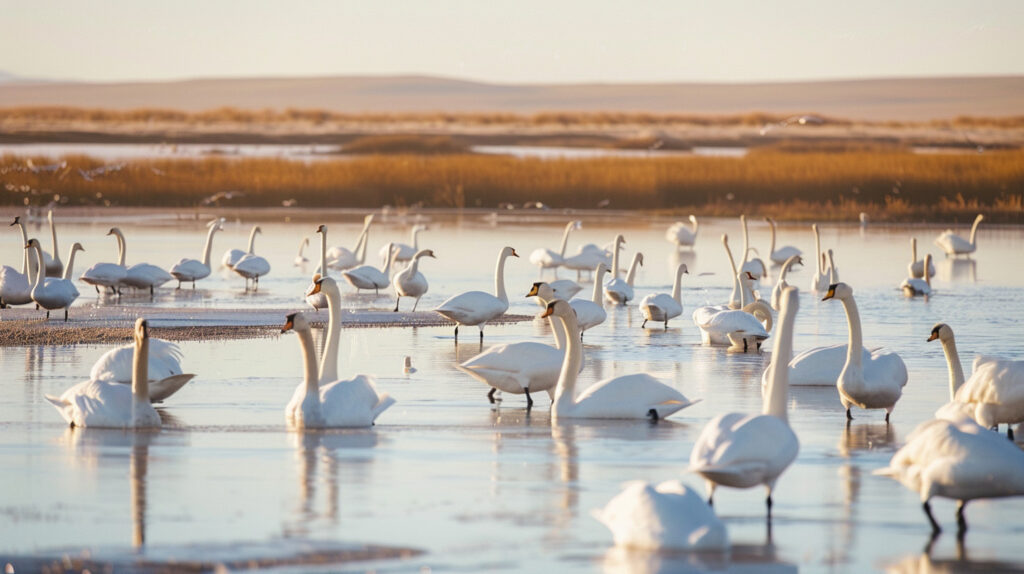
Every spring and autumn, Mongolia becomes one of Asia’s most dramatic bird migration corridors. Thousands of swans crossing Mongolia descend onto remote desert and steppe lakes, transforming empty landscapes into living, moving wetlands.
For birdwatching fans, wildlife photographers, and nature travelers, this seasonal phenomenon — especially in the Gobi Desert and eastern steppe lakes of Sukhbaatar Province — is one of the most visually striking wildlife spectacles in Mongolia.
Mongolia on the Central Asian Flyway
Mongolia lies directly beneath the Central Asian Flyway, one of the most important migratory bird routes on Earth. During spring (April–May) and autumn (September–October), vast numbers of migratory birds — especially swans — cross Mongolia on journeys between Arctic breeding grounds and East Asian wintering areas.
The most iconic species is the Whooper Swan, whose powerful calls and large formations make migration impossible to miss. Smaller numbers of Tundra Swan also pass through Mongolia during peak migration windows.
Why Swans Gather in the Gobi Desert
At first glance, the Gobi Desert seems inhospitable to water birds. Yet the Gobi hides a network of freshwater and saline lakes, sustained by underground springs, snowmelt, and seasonal rivers.
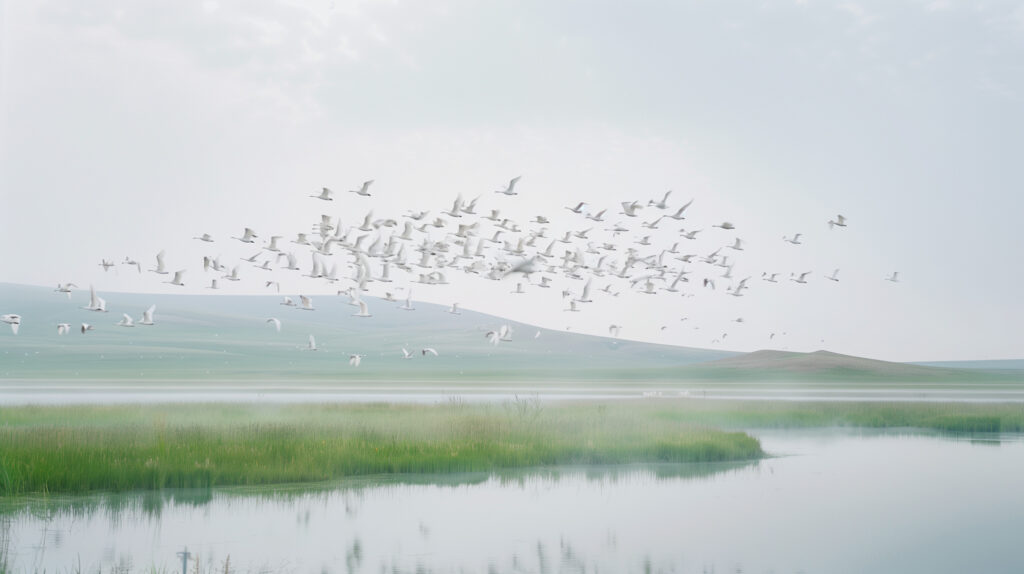
These lakes act as critical stopover habitats where swans:
- Rest after long-distance flights
- Feed on aquatic vegetation
- Regroup into large flocks
- Wait for favorable weather conditions
Because water sources are limited, swans concentrate heavily in specific lakes — creating extraordinary birdwatching and photography opportunities.
Key Gobi Lakes for Swan Migration
🦢 Taatsiin Tsagaan Lake
Taatsiin Tsagaan Lake is one of Mongolia’s most famous swan stopover sites. During peak migration, hundreds to thousands of swans may gather on its calm, open waters, often staying for several days.
🦢 Gobi-Altai Lakes
Remote lakes in the Gobi-Altai Mountains host quieter but equally important gatherings, ideal for ethical birdwatching with minimal disturbance.
Eastern Mongolia & Sukhbaatar Province: The Steppe Swan Corridor
Beyond the Gobi, eastern Mongolia plays a crucial role in swan migration — especially Sukhbaatar Province, where wide-open steppe meets shallow freshwater lakes.
Why Sukhbaatar Lakes Matter
- Located directly on the migration corridor
- Open visibility across flat grasslands
- Shallow waters ideal for swans and geese
- Fewer visitors than western Mongolia
Swans often arrive here in large synchronized flocks, creating dramatic landings and mass take-offs — a dream scenario for wildlife photography in Mongolia.
These steppe lakes act as a bridge between Siberia and East Asia, making Sukhbaatar one of Mongolia’s most underrated birdwatching regions.
A Paradise for Wildlife Photography
The contrast of white swans against desert and steppe landscapes makes Mongolia unique among global birdwatching destinations.
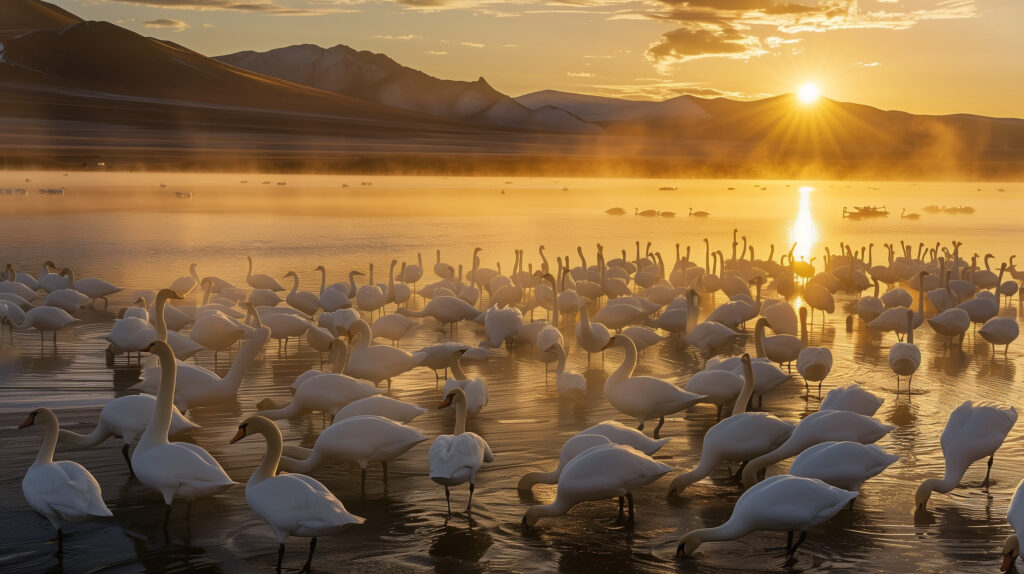
Wildlife photographers love:
- Dawn and dusk reflections on still lakes
- Long flight formations
- Vocal interactions and courtship displays
- Mixed-species compositions
Unlike crowded birding hotspots elsewhere, birdwatching in Mongolia offers silence, space, and natural behavior — no hides, fences, or crowds.
Best Time for Swan Migration in Mongolia
🌱 Spring Migration (April–May)
- Ice breaking on lakes
- Dramatic arrivals
- Active calling and movement
- Excellent action photography
🍂 Autumn Migration (September–October)
- Larger flock concentrations
- Softer light and calmer weather
- Birds resting before long southbound flights
- Ideal for observation and composition
Bird Species Checklist – Swan & Waterbird Highlights
During swan migration seasons, birdwatchers in Mongolia may observe:
🦢 Swans
- Whooper Swan
- Tundra Swan
🪶 Other Waterbirds
- Bar-headed Goose
- Swan Goose
- Greylag Goose
- Demoiselle Crane
- Common Crane
- Dalmatian Pelican
🦅 Raptors Often Seen Near Lakes
- Steppe Eagle
- Eastern Imperial Eagle
- Saker Falcon
- Lammergeier (Bearded Vulture)
This diversity makes swan migration in Mongolia a complete birdwatching experience, not just a single-species event.
Conservation Importance of Gobi & Steppe Lakes
These lakes are lifelines. Without them, migratory birds crossing Mongolia would not survive their journeys.
Protecting these habitats supports:
- Global bird migration systems
- Wetland biodiversity
- Desert-steppe ecosystems
Responsible birdwatching tourism helps raise awareness and local value for these fragile landscapes.
Experiencing Swan Migration with Explorer.Company
At Explorer.Company, swan migration journeys focus on:
- Ethical birdwatching
- Remote lake access
- Small-group photography travel
- Deep immersion in Mongolia’s wild landscapes
From the Gobi Desert lakes to the steppe wetlands of Sukhbaatar Province, witnessing swans crossing Mongolia is a rare, powerful reminder of nature’s scale and rhythm. Wildlife watching and wildlife photography tours in Mongolia are incredible once in a lifetime trips with extraordinary experiences far of the beaten tracks.
Final Thoughts
When thousands of swans descend onto quiet lakes in the Gobi and eastern steppe, Mongolia reveals one of its most poetic moments. Wings beat the air, calls echo across empty land, and for a brief time, desert and steppe become sanctuaries.
For birdwatchers and wildlife photographers, swan migration in Mongolia is not just a sight — it is a spectacle of movement, survival, and wild beauty.
 English
  German
  Arabic
  Spanish
  Italian
  Korean
  French
  Dutch
Dutch  Polish
  Russian
  Chinese