


There are places in the world where culture is something you observe, like museums, dances, and guided performances neatly scheduled. And then there’s Western Mongolia, where culture is something you live through. You don’t just visit and observe; you share tea with nomads, trade smiles across language barriers, and watch ancient traditions unfold beneath wide skies.
Culture is something to experience here, not witness.
If Mongolia is a country built on the spirit of the steppe, Western Mongolia is its beating heart; raw, proud, and timeless. It’s where Kazakh eagle hunters still ride into the mountains with their golden companions, where summer festivals echo with throat singing and horse races, and where nomadic families still move with the rhythm of the land.
For travelers planning a self-drive tour in Western Mongolia, these cultural encounters aren’t side attractions; they are the whole experience. Opting to self-drive gives you access to the remote communities and living traditions that define this region. This guide dives into the people, festivals, and ways of life that make a Western Mongolia road trip unforgettable.
Here are some of the unique cultural encounters you can expect to have along the way.
Life Among the Nomads
No image captures Mongolia better than a solitary ger silhouetted against a horizon of endless grassland. Yet behind that image lies a complex, enduring culture of resilience and hospitality. Roughly one-third of Mongolia’s population still leads a nomadic or semi-nomadic lifestyle, and in the west, among the Altai Mountains and open steppe, this way of life remains remarkably intact.
Driving through these landscapes, you’ll spot stark white gers dotting the valleys like stars fallen from the sky. Pull over, and you might be greeted with a wave or an invitation to sit for tea. Nomads in Mongolia are famously welcoming; hospitality here isn’t just a courtesy, it’s a code of survival.
Inside a ger, the air is warm from a dung-fueled stove, and your host will likely pour you suutei tsai (salty milk tea) or offer aaruul (dried curd). Conversations unfold through gestures, laughter, and shared curiosity. You might learn that the family is preparing to move to their summer pasture, or that their eldest son just returned from herding yaks near the Chinese border.
Staying overnight with a nomadic family during your Western Mongolia self-drive tour offers a rare window into this rhythm of life, one guided not by clocks or calendars, but by the seasons and the needs of animals.
Kazakh Culture and the Eagle Hunters of Bayan-Ölgii
Western Mongolia’s Bayan-Ölgii Province is home to the country’s Kazakh minority, whose culture feels distinct even within Mongolia’s borders. They speak their own Turkic language, practice Islam, and maintain a centuries-old tradition that has become an icon of Mongolian identity, the infamous eagle hunting.
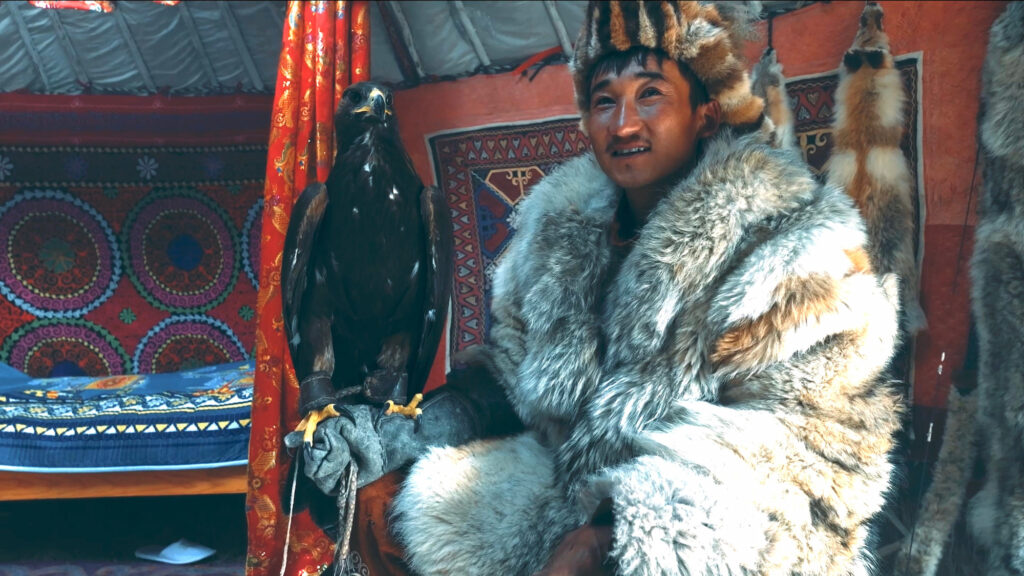
Kazakh eagle hunters, or berkutchi, train golden eagles to hunt foxes and hares on horseback, forging a bond between human and bird that feels almost mythical. Seeing this in person, not at a performance, but in the wild landscapes where it truly belongs, is one of the most powerful travel experiences you can have anywhere on earth.
During an Eagle Hunters Mongolia tour or as part of a self-drive Altai road trip, you can visit hunter families in villages like Sagsai and Altantsogts, where the tradition lives on through the generations.
In late September and early October, eagle hunters gather for the Golden Eagle Festival in Ulgii, a two-day celebration of skill, speed, and heritage. You’ll see hunters in embroidered coats galloping across the plains, calling their eagles to their arms mid-flight. Between competitions, there are horse races, archery contests, and dances — a whirlwind of color and pride set against the rugged Altai backdrop.
For photographers and cultural travelers, it’s pure magic. But even outside festival season, meeting the eagle hunters in their homes offers a quieter, more personal experience, one that captures the soul of Mongolia’s western frontier.
Speaking of Western Mongolia’s Festivals…
Western Mongolia’s many festivals aren’t staged for foreign tourists — they’re vibrant expressions of community and identity. If your Mongolia road trip itinerary aligns with one of these gatherings, it’s worth planning around.
- Nauryz (Kazakh New Year) – March
In Bayan-Ölgii, the Kazakh community celebrates Nauryz, marking the spring equinox and the start of the new year. Families prepare beshbarmak (a hearty meat and noodle dish), and locals gather for traditional games like kokpar, where horsemen wrestle for control of a goat carcass in a display of strength and strategy.
- Naadam Festival – July
Every Mongolian province hosts its own Naadam Festival, a celebration of the “three manly sports”: wrestling, horse racing, and archery. Western Mongolia’s version is smaller and more intimate than Ulaanbaatar’s, allowing you to get up close to the action and the community energy. Children as young as six race horses across the plains, while local wrestlers perform elaborate pre-match dances.
- Golden Eagle Festival – October
The star of the west. Held in Ulgii, this annual event draws eagle hunters from across Bayan-Ölgii, along with travelers from around the world. Beyond the eagle competitions, it’s a gathering that honors Kazakh culture through music, crafts, and traditional attire.
If you’re planning a Mongolia self-drive tour to Altai, consider timing your visit to coincide with at least one of these festivals, as they offer unmatched insight into the spirit of Mongolia.
Driving Through Tradition: Connecting Culture by Road
The beauty of a Western Mongolia off-road driving adventure is that it connects you to the country’s culture in real time. Roads lead not just to destinations, but to encounters. And sometimes that encounter is with the vast landscape and the road itself.
In Western Mongolia, your journey might begin in Ulgii, a town with bustling markets and traces of Soviet architecture. From there, the road winds past Tolbo Lake, through remote valleys dotted with grazing camels and yak herds, and onward to the high mountain passes of Altai Tavan Bogd National Park.
Along the way, you might see herders moving entire households on flatbed trucks, their gers packed neatly beside sheep and children. You’ll pass prayer flags fluttering in the wind, and stone ovoos, the sacred cairns, marking high mountain passes where travelers stop to offer a blessing.
Driving in Mongolia is equal parts actual navigation and intuition. GPS only gets you so far. Sometimes, it’s a herder’s hand pointing across the horizon that guides you to your next destination.
The journey itself becomes a cultural exchange — a rolling lesson in patience, adaptability, and wonder.
Altai Tavan Bogd National Park: The Cultural & Natural Crossroads
At the edge of Mongolia’s borders with Russia and China lies Altai Tavan Bogd National Park, a vast wilderness of glaciers, alpine lakes, and ancient petroglyphs. While most come here for trekking and photography, the park is also a living cultural landscape. This is one of the best destinations for those hoping to dive deeper into the Western Mongolian culture.
Within its valleys live Tuvan herders, Kazakh families, and Mongolian nomads, each distinct group coexisting in shared respect for the land. Visiting the park by car with an Avis rental allows you to reach remote campsites like White River Base Camp, where you can hike toward the Potanin Glacier or visit the sacred Khuiten Peak, Mongolia’s tallest mountain.
As you drive deeper into the park, you’ll find Bronze Age carvings etched into stones — reminders that this land has been home to travelers and traders for thousands of years. Few places so perfectly merge Mongolia’s culture and wilderness into a single panorama.
Driving Tips for Cultural Travelers
If you’re planning to connect these cultural highlights on a road trip in Mongolia, here’s what to keep in mind:
- Go slow. Driving in Mongolia is not about covering distance; it’s about depth. Leave space in your schedule for unexpected encounters.
- Pack gifts. Small items like tea, fruit, or postcards are appreciated by nomadic families when you visit their gers.
- Respect boundaries. Ask before photographing people, especially elders or religious sites.
- Stay flexible. Weather can shift fast in the Altai; roads can disappear in a flash flood or snowstorm. Embrace the uncertainty, it’s part of the story.
- Rent wisely. A reliable 4×4 is non-negotiable. Avis Mongolia self-drive tours offer sturdy vehicles, local support, and curated routes that include cultural highlights and natural wonders alike.
Culture Seekers Will Love Western Mongolia
The few people who do make it out to Western Mongolia on their own terms aren’t enough to create a mass tourism industry. This means the ancient practices and traditions of the Mongol people are preserved and still relatively easy to experience organically. When compared to heavily trafficked areas like the Gobi Desert, the difference in cultural exchange is noticeable.
Every traveler leaves Western Mongolia changed. Maybe it’s the silence — that profound, humming quiet of the steppe. Maybe it’s the people — their strength, humor, and hospitality. Or maybe it’s the realization that life here, though simple, is deeply rich in connection.
A self-drive tour through Western Mongolia isn’t just a road trip. It’s a passage through time, a chance to see a culture that hasn’t bent to modern convenience, where ancient traditions still thrive under the same stars that once guided Genghis Khan’s riders.
For those who crave authenticity, space, and the thrill of discovery, the west isn’t just Mongolia’s best-kept secret; it’s its soul.
 English
  German
  Arabic
  Spanish
  Italian
  Korean
  French
  Dutch
Dutch  Polish
  Russian
  Chinese